Nighttime Culture Index (NCI)
Nighttime Culture Index: Measuring the Cultural Vitality of Cities After Dark
What makes a city’s nighttime culture thrive, and who gets to be part of it?
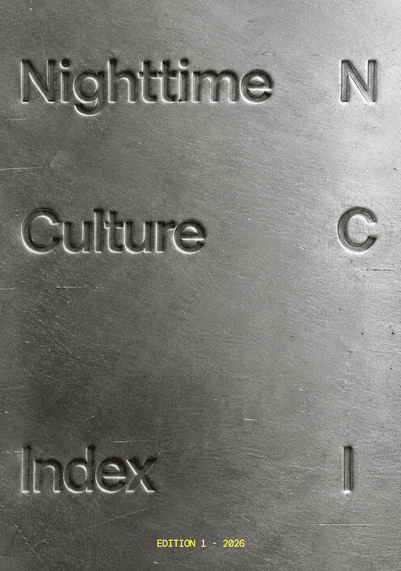
Developed by ADE and VibeLab, the Nighttime Culture Index is a new research initiative examining nighttime culture worldwide. First edition started with Amsterdam, Lagos, New York, São Paulo, Seoul and Sydney. Through six research dimensions and 30 indicators, NCI explores the conditions shaping cultural life after dark, from affordability and safety to diversity, infrastructure and city policy.

What did the first edition of NCI research find?
Access is unequal: A typical club night costs around one hour of minimum-wage work in Sydney, compared with nine hours in São Paulo and 25 hours in Lagos.
Representation needs to improve: Female and gender-diverse artists account for just 27–32% of line-ups across the six cities, while venue ownership and leadership remain largely male-dominated.
Safety goes beyond the club: People in all six cities reported feeling less safe on nightlife-area streets than inside venues.
Culture needs a place in city policy: Nighttime governance often prioritises business and tourism over the cultural ecosystems that make cities come alive after dark.
The findings reveal a central contradiction: nighttime culture is thriving, but access to it and the systems needed to sustain it remain unequal.
Explore the full NCI dashboard and discover what the data tells us about the future of nighttime culture.
What did the first edition of NCI research find?
Access is unequal: A typical club night costs around one hour of minimum-wage work in Sydney, compared with nine hours in São Paulo and 25 hours in Lagos.
Representation needs to improve: Female and gender-diverse artists account for just 27–32% of line-ups across the six cities, while venue ownership and leadership remain largely male-dominated.
Safety goes beyond the club: People in all six cities reported feeling less safe on nightlife-area streets than inside venues.
Culture needs a place in city policy: Nighttime governance often prioritises business and tourism over the cultural ecosystems that make cities come alive after dark.
The findings reveal a central contradiction: nighttime culture is thriving, but access to it and the systems needed to sustain it remain unequal.
Explore the full NCI dashboard and discover what the data tells us about the future of nighttime culture.
Review all the key findings of the Index, as well as spotlights on Amsterdam, Lagos, New York, São Paulo, Seoul and Sydney.
Discover how Amsterdam, Lagos, New York, São Paulo, Seoul and Sydney score across the six research dimensions and all 30 indicators.
Nighttime Culture Index: Measuring the Cultural Vitality of Cities After Dark
How healthy is nighttime culture around the world, and what does it take to sustain it?
Launched at ADE’s 30th anniversary edition, the Nighttime Culture Index (NCI) is a joint initiative by Amsterdam Dance Event and VibeLab, providing a new framework for understanding and measuring nighttime culture worldwide. First edition kicked off with six cities: Amsterdam, Lagos, New York, São Paulo, Seoul and Sydney.
Through six research dimensions: Creative Ecology, Space & Infrastructure, Diversity & Representation, Community & Belonging, Policy & Civic Health, and Sustainability & Environment, the Index examines the conditions that enable nighttime culture to thrive. Its 30 indicators explore everything from cultural activity and access to safety, representation, affordability and the ways cities support their nighttime ecosystems.
The research combines desk research, expert interviews, data collection, a public survey and focus groups. Across the six cities, the team analysed more than 12,000 event line-ups, assessed over 3,000 venues and researched close to 30,000 non-music cultural events, alongside insights from more than 700 survey respondents, 67 focus group participants and 14 nighttime culture experts.
What does the research reveal?
A night out is far more expensive in some cities than others.
The cost of a night out varies dramatically between cities. Entry to a typical club night costs approximately one hour of minimum-wage work in Sydney, compared with nine hours in São Paulo and around 25 hours in Lagos. The availability of dedicated music venues also differs considerably, highlighting the importance of grassroots, DIY and public spaces in creating opportunities for emerging artists and collectives.
Women and gender-diverse artists make up under a third of line-ups, and men still run the venues
Female and gender-diverse artists account for between 27% and 32% of line-ups across the six cities. Meanwhile, experts in five cities rated diversity in venue ownership and leadership as poor. Grassroots, alternative and queer scenes are often leading the way in developing more inclusive events and safer spaces, but rising costs threaten these practices.
Nighttime venues do serve as a “safer space”, but by contrast, feelings of safety drop sharply once outside venues
Across all six cities, people reported feeling less safe in nightlife-area streets than inside venues. In São Paulo, 73% of respondents said they felt safe inside venues, compared with just 11% in the streets. In Lagos, the figures were 74% and 20%, respectively. These concerns influence participation, with many respondents reporting that they had avoided going out or visiting particular places because of safety concerns.
Cities are governing the night as an economy, not a culture
While more cities are establishing dedicated nighttime offices or government roles, their remits often focus on business, tourism and economic activity. The research points to the need for approaches that recognise nighttime culture as an essential part of urban cultural life, supported by collaboration between policymakers, artists, venues, promoters and communities.
Building a global network for more sustainable nighttime culture
The findings reveal a central contradiction: nighttime culture is thriving, but access to it and the systems needed to sustain it remain unequal. Across all six cities, the research highlights both the resilience of local scenes and the opportunities to build more inclusive, supportive frameworks for their future.
The NCI provides cities, policymakers, cultural organisations and the nighttime industry with a shared evidence base to understand local realities, identify challenges and make more informed decisions. It also establishes a baseline for tracking progress and change over time.
Explore the Nighttime Culture Index
Review all the key findings of the Index, as well as spotlights on Amsterdam, Lagos, New York, São Paulo, Seoul and Sydney.
Discover how Amsterdam, Lagos, New York, São Paulo, Seoul and Sydney score across the six research dimensions and all 30 indicators.


