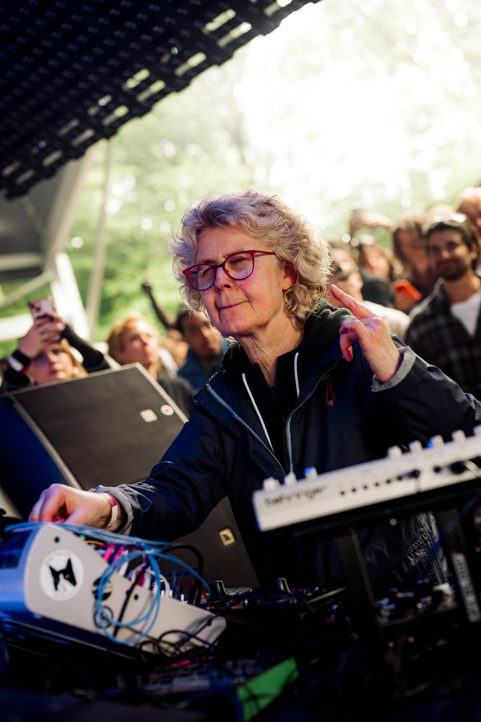
The Tunegirl (DE)
Andrea Gill, better known as TuneGirl, has been passionate about music since the 1970s. Growing up as a devoted hard rock fan, she was inspired by bands such as Status Quo and AC/DC. Determined to play electric guitar, she eventually convinced her parents to buy her first guitar and amplifier. She became the guitarist in her school band, where the group performed covers of their favourite artists alongside original material, earning a local following and building a strong musical foundation entirely by ear.
During the 1980s, Andrea's musical interests expanded into funk and soul, captivated by their infectious grooves and rhythms. Around the same time, she worked as a DJ at a local club, spinning disco, soul and funk classics from the 1970s and 1980s. It was also during this period that she discovered synthesizers, sparking a fascination with electronic instruments. Influenced by the rise of synth-pop acts such as Depeche Mode, The Human League and Duran Duran, she began exploring new sonic possibilities.
Andrea later discovered techno through pioneering artists including Jeff Mills, Robert Hood, Steve Stoll, Richie Hawtin and K. Hand. Their minimalist productions, drum machine precision and innovative sound design left a lasting impression and inspired her to create electronic music herself. Equally drawn to Detroit techno, minimal, acid, Chicago house, New York house and vocal house, she developed a deep appreciation for the broader spectrum of electronic music.
She built her first studio around classic hardware including an Atari computer running Steinberg Cubase, Roland synthesizers, a TR-707 drum machine and Akai samplers. Although she stepped away from music production in 1999 for family reasons, she returned in 2009, initially working entirely in software with tools such as Reason and Ableton Live. While she appreciated the flexibility of digital production, she missed the spontaneity and hands-on creativity of hardware.
That search ultimately led Andrea to modular synthesis. After discovering Eurorack through online videos and dedicating herself to learning synthesis from the ground up, she gradually built her own modular system. What began as a challenging learning process evolved into the instrument that perfectly matched her creative approach. Today, Eurorack remains at the heart of her artistic practice, allowing her to create immersive, improvised techno performances driven by experimentation, sound design and live expression.
The Tunegirl Opens Up
Felix Meritis 15:30 View EventThe Tunegirl and Esther (Estroe) Featured Highlights / Artists / ADE Pro / Keynotes, Talks & Panels
Club Baggerbeest Presents: The Tunegirl (Live)
Club Baggerbeest 23:00 View EventNighttime events / Club nights / Live Performances / Techno